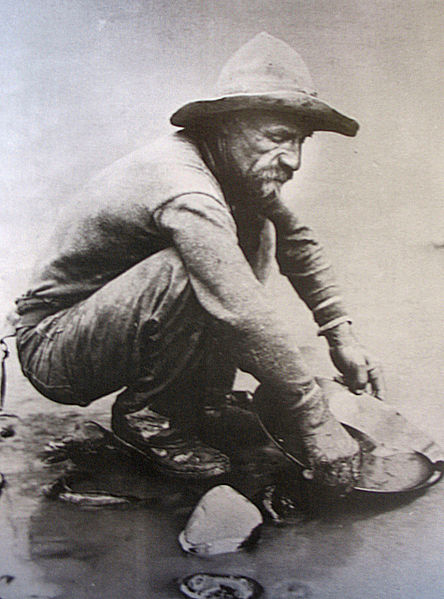
Carpenter James Marshall discovered gold at Sutter’s Mill in 1848, the same year the United States defeated Mexico in the American-Mexican War and gained the California Territory. John Sutter hired over one hundred men to build his gristmill and the eight-mile race, or ditch, carrying water to the mill. He put Marshall in charge of the project.
A worker named James S. Brown wrote about his experiences in 1894 and preserved for history the very moment Marshall noticed a glint near his feet. “Mr. Marshall called me to come to him. I went, and found him examining the bed rock. He said, “This is a curious rock, I am afraid it will give us trouble,” and as he probed it a little further, he said, “I believe that it contains minerals of some kind, and I believe that there is gold in these hills…” News of the discovery spread quickly, and people looking to make their fortunes flooded the new territory.
This “rush” began in 1849, and the people involved became known as “49’ers.” The California Territory’s population exploded between 1848 and 1850 from an estimated several thousand to almost 100,000. No one knows exactly how much gold prospectors found in California, but estimates are usually around 750,000 pounds.
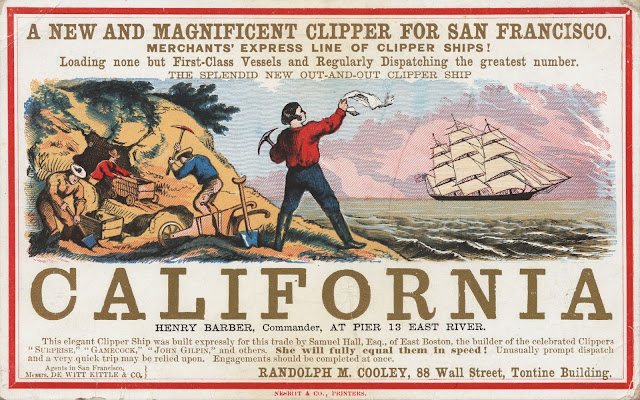
United States Army Colonel Richard Mason toured the gold region of California in July of 1848 and sent a detailed report to Brigadier General Roger Jones in Washington, D.C. “A small gutter, not more than 100 yards long by four feet wide, and two or three deep, was pointed out to me as the one where two men (W. Daly and Percy M’Coon) had a short time before obtained 17,000 dollars worth of gold… Hundreds of similar ravines, to all appearances, are as yet untouched.”
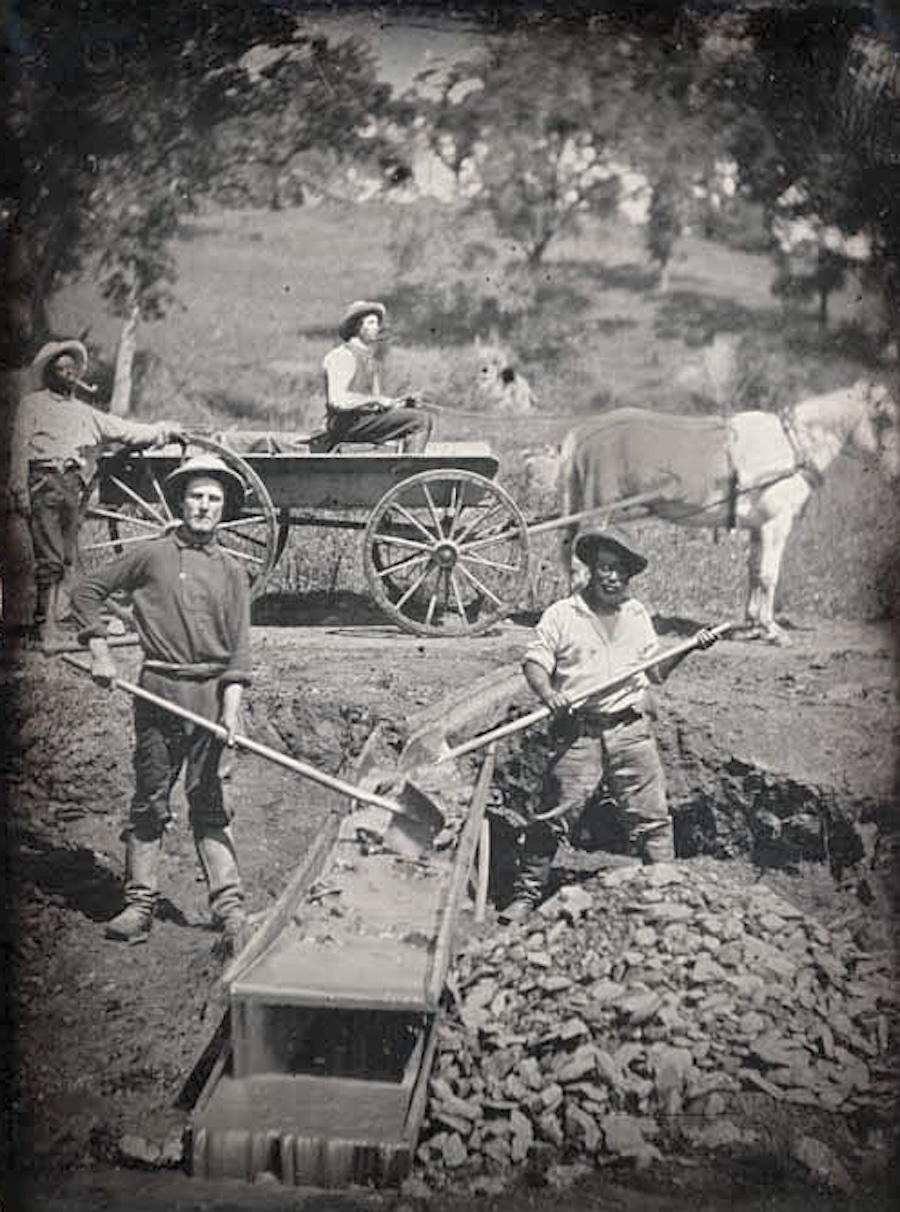
Finding gold proved to be harder work than many had expected. Prospector Augustine Hubbard wrote in a letter to his brother on September 4th, 1850, “After looking about a few days… we commenced digging for gold, and we soon found that, although, in imagination it might be agreeable work, yet in reality, it was the most laborious and in the majority of cases the most unsatisfactory that men could be engaged in.” Some prospectors made fortunes in gold, but most did not and much of the easy-found gold was gone within a few years.
Gold Rush Fortunes and Heartbreaks provides 6th through 8th graders thought-provoking content and activities necessary to experience the thrills, risks, and dreams of the California Gold Rush. The materials found in this resource can be used as stand-alone lessons complementing your existing curriculum or as a complete seven-day mini-unit. Immerse your students in the Gold Rush’s dramatic times of adventure and dreams through Gold Rush Fortunes and Heartbreak’s comprehensive and engaging learning experiences.
References and Image Credits
Brown, James S. “California Gold; an authentic history of the first find, with the names of those interested in the discovery; published by the author, James S. Brown, Salt Lake City, Utah. Oakland Cal., Pacific press publishing company 1894.” Reprinted by William Abbatt in The Magazine of History with Notes and Queries. Vol 48, No.3. 1933. New York. Library of Congress Website. Accessed 3/16/25
Four Prospectors Look for Gold Near the Town of Spanish Flat. 1852. Retrieved 1/22/26. California State Library. Public Domain.
Hibbard, Augustin, excerpt from “Letter from Augustin Hibbard to William Hibbard 1850 Sept. 4,” Digital Public Library of America. Accessed 3/16/25
Mason, Richard Barnes. “Letter to Brigadier-General R. Jones, Adjutant-General, U.S.A.” August 17th, 1848. Richard Barnes Mason papers, BANC MSS C-A 107, The Bancroft Library, University of California, Berkeley.
Prospector Panning for Gold. 1850. L.C. McClure Photographer. Retrieved 2/19/25. Public Domain.Sailing Card for the Clipper Ship California. Circa 1850. Retrieved 2/19/25. G.F. Nesbitt & Co., printer. Public Domain.
 david cooper writing
You must be logged in to post a comment.