Academic interventions are more than individualized action plans designed and implemented to improve failing grades. Mindfully and cooperatively designed interventions provide opportunities to build relationships and soft skills related to emotional intelligence, adaptability, and resiliency. Delving into some of the philosophies behind the practice of intervention can also provide educators with new insights into assessment, which can have a positive impact on all students.

Who gets an intervention plan?
Intervention techniques can be used with students whose grades fall into numerical ranges traditionally considered to be “satisfactory” or better, not just with those considered “at-risk” in the traditional sense. The concept of failure is more subjective than an “F” appearing at the top of an assessment or column of a grade report. Consider the parents who share with you their child, “received all A’s and B’s until starting middle school.” I heard this phrase many times on the phone, at the conference table, and read it in emails during my thirty years as a teacher. A “C” can cause a young person accustomed to receiving higher grades to question self-concepts, and we need to pay due attention to these students before such questions lead to discouragement and perhaps less positive self-concepts.
How can academic interventions help students reframe “failure?”
Students often need help disentangling grades from self-concepts and notions of permanency. Establishing a working relationship to address openly feelings connected with receiving poor grades is pivotal in preventing these feelings from becoming thoughts of being a failure. Normalizing and speaking openly about struggle helps to organize thinking and eases feelings of frustration (see “Why Talking Through Problems Can Make You Smarter” by Chloe Carmichael at psychologytoday.com for a primer on this topic). Stress to the student poor grades are temporary— “this too shall pass”— with planning and effort. Consider the following when you approach a student needing an academic intervention:
1) Try to establish how the student feels and what the student thinks before diving into a discussion of grades, tests, quizzes, and the like.
- “I see you are struggling right now. Can you tell me how you are feeling or doing?”
- “What are your thoughts about your classes and grades?”
- “Can you tell me what is making you think or feel this way?”
2) Share examples of how you (as a person with a life outside of school) felt derailed if the opportunity presents.
- What happened?
- How did the derailment make you feel?
- How did you get back on track?
Don’t linger too long on the emotional implications of where the student stands— we want students to move beyond negative thinking. Explore just enough to show you recognize and honor what the student feels, to identify factors which may be contributing to the struggle, and to determine and address what the student is thinking.
How can academic interventions address soft skill development?
Opportunities to guide students in developing soft skills often happens outside our planned learning experiences. Academic interventions can help students build emotional intelligence, adaptability, and resiliency. Recognizing then putting names to feelings connected to performance early in the intervention is an exercise in self-awareness, which is a fundamental emotional-intelligence skill. Realizing these feelings are temporary, like grades, encourages participation in a remediation and reassessment. This is the ideal point to develop an action plan (the intervention’s nuts and bolts) with the student. Finally, experiencing successful outcomes from supported interventions in the form of improved grades promotes resiliency. The more students experience the connections between recognizing feelings, the normalcy of struggle, and seeing success through action, the better students will be able to bounce back from future adversity.
How can academic interventions lead us to rethink assessment philosophies?
Academic interventions often rely upon two beliefs regarding the practice of assessment. First, well-designed assessments are learning experiences as well as tools for measuring students’ knowledge and skills. Second, assessments represent knowledge and skills deemed important for students’ lives. Educators adhering to these beliefs allow students to reexperience assessment tools and complete work beyond deadlines (with or without penalties) in the hopes they acquire, eventually, the knowledge and skills deemed important. These beliefs also open the intervention door to more students, like those getting a “C” for the first time in their academic careers.
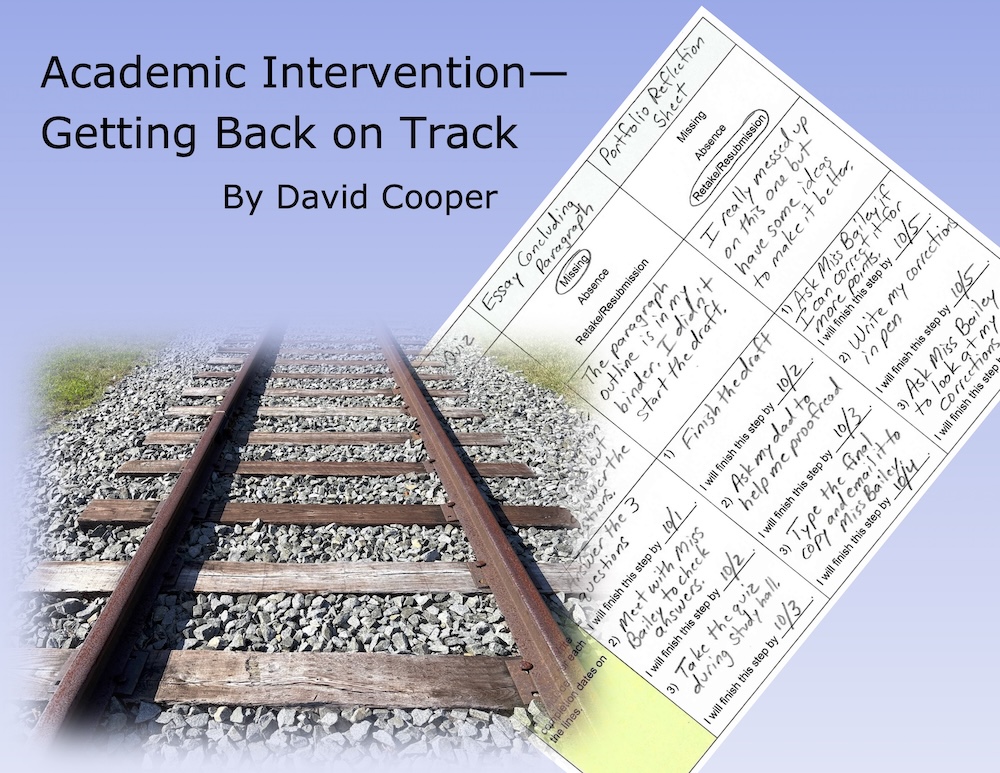
Academic Intervention—Getting Back on Track is a positively-framed resource to help students in grades four through nine improve grades, regain self-confidence, and realize everyone experiences challenging times. Prompts and recommendations provide the tools to approach and encourage students in need of academic supports. Step-by-step procedures, a conference planning sheet, a student-driven checklist and organizer, and a set of prompts to coach and encourage help educators empower students to take control of their learning.
How do I encourage and coach a student working through an academic intervention plan?
Check-ins with students including encouragement, monitoring of progress toward an action plan’s benchmark dates, and celebrating the achievement of benchmarks go a long way toward an intervention’s success. Students developing the executive functioning and soft skills to be self-sufficient need more than a detailed action plan. Check-ins can be anything from a passing “How is your math study guide coming along?” in the hallway to a scheduled sit-down during homeroom. Reinforce the notion the student is not alone, and teachers are invested in the student’s success. Staying connected during the execution of an action plan is essential to convey feelings of genuine and committed support.
 david cooper writing
You must be logged in to post a comment.