Reader groups have helped my writing short-game. Spelling errors, grammar foibles, scene inconsistencies— you name it, readers have found it in my articles and short story drafts and have guided me through corrections. I cannot begin to describe all I’ve learned from engaging in the writing process with those who love story-telling and the craft, and the time has come for me to take all of this to the next level, to form a group to review one of my novel drafts. Can’t be much different than a short story group, right? If only this were true. Some fundamental and not easily-solved questions come to mind as I consider this question and plan for the next big step in my novel’s development.
Who will I invite to the group? I can’t keep going back to the same well, impose upon the same readers who have helped me piece together the smaller parts of my novel. I need fresh eyes, and I need to give my usual readers a well-deserved break.
When should I expect feedback? Many of my teacher friends struggle to keep their heads above water grading papers, writing lesson plans, completing evaluations— the thoughts passing through their minds would be the same passing through mine. I really wish I could help, but…
How do I invite readers and ask for specific help without making the task onerous? I want my readers to enjoy the read while engaging the writing process with me. If approached with too high and/or poorly communicated expectations, like reading and marking-up a complete novel in a demanding time frame, readers could be turned off from the project. Even turned off from me.
Tackling who will I invite to the group? involves finding readers who trust enough in our relationships to identify, without hesitation, the problems with my work. Limiting feedback to a work’s strengths risks allowing the writer to submit something less than his or her best to a prospective publisher or agent, which brings with it the sound of closing doors.
Addressing when should I expect feedback? requires patience, realism, and some respect. Highly-skilled and conscientious people tend to be busy, because they are highly skilled and conscientious. Readers need time. Pressure from me is not only unfair but not helpful– even hurtful. I need patience to look realistically at my schedule, input from my group regarding their schedules, and to use all of this information to frame my requests. If I won’t have time until three months from now to put feedback to real use, then why should I expect to receive anything sooner?
Answering the question how do I invite readers and ask for specific help without making the task onerous?calls for some self-discipline. My teacher mind often defaults to providing step-by-step procedures. Not always a helpful first step. Making the space and framing expectations so readers can enjoy my draft– hopefully– while providing specific feedback can be mutually-perpetuating objectives as long as the emphasis remains on the readers’ enjoyment. Enjoyment before feedback.
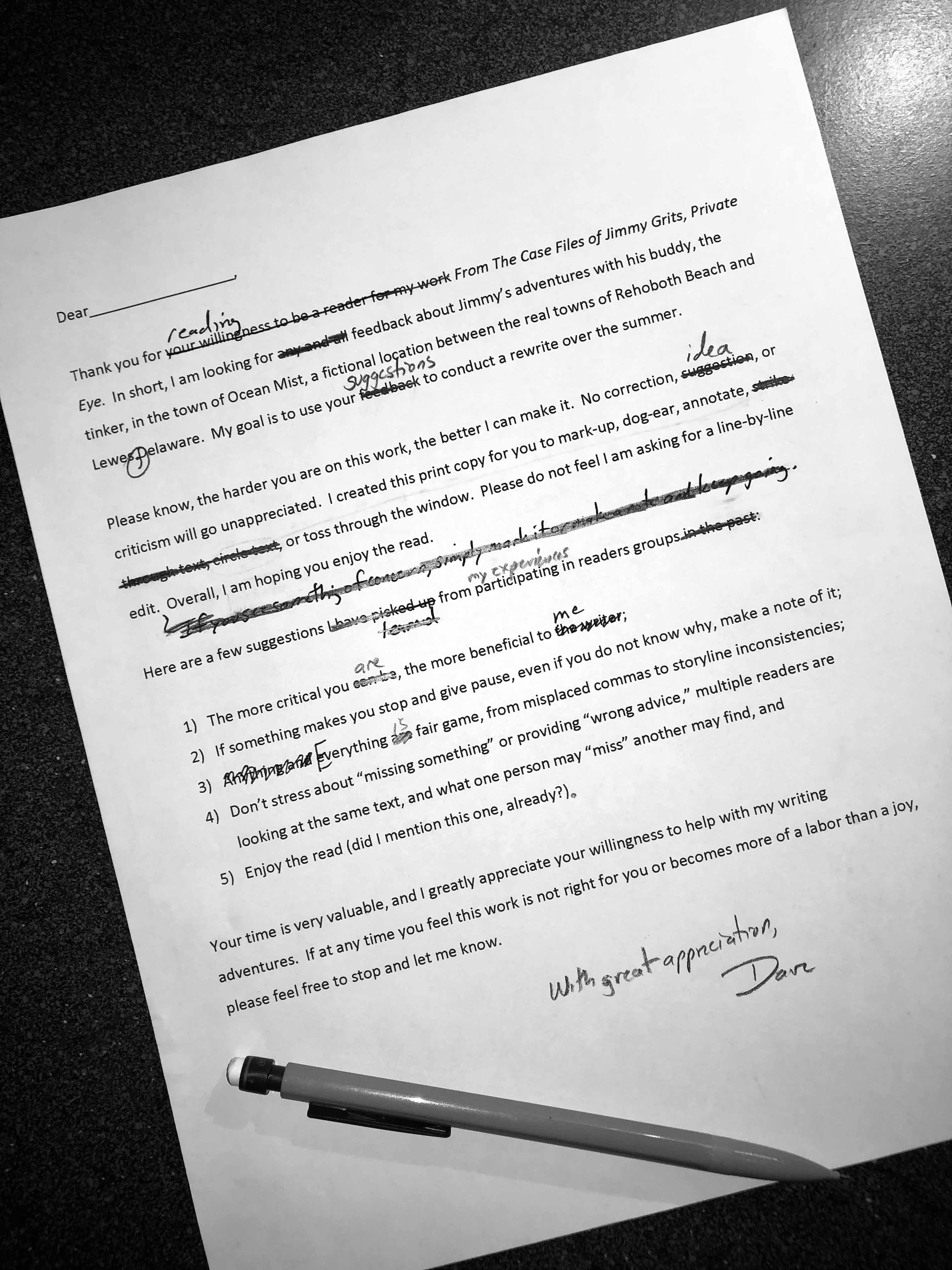
All of this processing leads to what I hope is a reader-centered cover letter expressing my desire for the brutal truth, balancing their schedules with mine, and emphasizing what I hope will be their enjoyment.
Dear_______,
Thank you for reading From The Case Files of Jimmy Grits, Private Eye. In short, I am looking for feedback about Jimmy’s adventures with his buddy, the tinker, in the town of Ocean Mist, a fictional location between the real towns of Rehoboth Beach and Lewes, Delaware. My goal is to use your suggestions to conduct a rewrite over the summer.
Please know, the harder you are on this work, the better I can make it. No correction, idea, or criticism will go unappreciated. I created this print copy for you to mark-up, dog-ear, annotate, or toss through the window. Please do not feel I am asking for a line-by-line edit. Overall, I am hoping you enjoy the read.
Here are a few suggestions from my experiences participating in readers groups:
- The more critical you are, the more beneficial to me;
- If something makes you stop and give pause, even if you do not know why, make a note of it;
- Everything is fair game, from misplaced commas to storyline inconsistencies;
- Don’t stress about “missing something” or providing “wrong advice,” multiple readers are looking at the same text, and what one person may “miss” another may find, and
- Enjoy the read (did I mention this one, already?)
Your time is very valuable, and I greatly appreciate your willingness to help with my writing adventures. If at any time you feel this work is not right for you or becomes more of a labor than a joy, please feel free to stop and let me know.
With Great Appreciation,
Dave
 david cooper writing
You must be logged in to post a comment.