Nancy Sakaduski of Cat and Mouse Press sent me a list of edits and revisions for my short story Moonwalker scheduled to appear this spring in the anthology Beach Pulp. She took great care making changes to improve the story’s flow, language, and formatting, like reducing the number of hyphens and phrases offset by em dashes. What interested me most by her edits were not the individual corrections so much as the stylistic improvements emerging, overall.
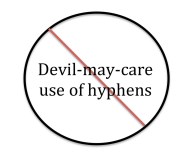 For instance, the number of hyphens in my work slowed the reader and stole attention from the scenes. If a writer’s goal is to help readers get lost in a story, word choice and constructions causing them to stop, slow, or even think, “Wow, that was a cool phrase,” work against us. For example, consider the original version of the previous sentence:
Before
If one of our goals as fiction writers is to help readers get lost in our stories, word-use and constructions causing them to stop, slow, or even think, “Wow, that was a cool turn-of-words,” work against us.
After
If a writer’s goal is to help readers get lost in our stories, word choice and constructions causing them to stop, slow, or even think, “Wow, that was a cool phrase,” work against us.
Sakaduski also eliminated some em dash phrases, something I picked up from reading literary fiction by writers much more skilled and experienced than me. Em dashes are used sometimes to break-up complex sentences and accentuate words, phrases, or clauses. An article posted on Grammarist.com’s website describes the em dash this way, “Perhaps a useful way to think of the em dash is as a pause or parenthesis with somewhat more emphasis than a comma and somewhat less than parentheses (https://grammarist.com/grammar/emdash/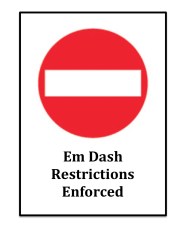 ).”
).”
By eliminating some em dashes and reducing the emphasis of these phrases to the level of commas, the reader’s eye and train of thought keep moving through the story instead of being made aware of the story’s conventions:
Before
Tawny found her aunt at a corner table with her mousy brown hair– a family trait Tawny knew too well– twisted into a hasty bun…
After
Tawny spotted her aunt at a corner table by her mousy brown hair, a family trait Tawny knew too well, which she had twisted into a hasty bun.
I like em dashes. Too much. Of those ultimately reading one of my stories, how many will truly care about crafty em dash use versus those looking for a few moments of escapism. Simplifying construction to keep readers’ eyes on the story will be an ongoing struggle for me. I am a fan of Cormac McCarthy, a master of literary fiction and writer known for creative word use and constructions (including the choice not to use quotation marks to indicate dialogue). See how the parenthetical pulled you from this article?
I am, by no means, a Cormac McCarthy, but his work has certainly influenced me. If only I had enough skill at this point in my career to implement these influences more effectively, maybe find a way to use creative constructions with a lighter touch and still immerse readers in my stories. Some day…
 david cooper writing
You must be logged in to post a comment.