A rubric’s validity is a matter of how trustworthy the grades are it generates. Measures are only as good as the tools providing the measurements, and, if a tool is faulty, we cannot trust the numbers it provides. A ruler can tell us a pencil is six inches unless the ruler’s markings are incorrect. The measurement is not valid. Two simple techniques can improve a rubric’s validity—keeping the numbers (quantifiers) small and bridging project requirements to specific qualifiers. The three rubrics presented here, A through C, illustrate how this is possible by showing progressive improvements in validity. The rubrics are based upon a project requiring students to write informative paragraphs using clear topic, body, and concluding sentences possessing at least four pieces of researched information.
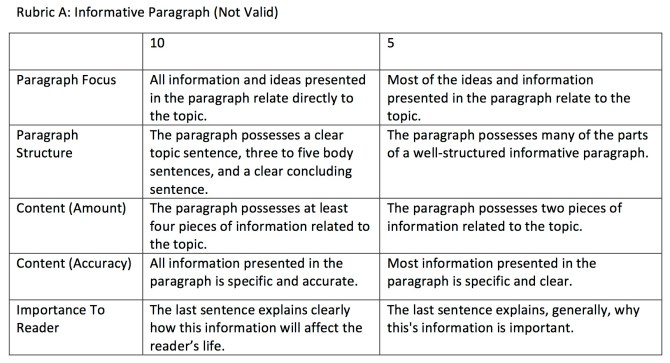
Imagine you are a parent and your child received a grade of 40/50 on rubric A. Weak paragraph structure (a poor topic sentence) and incorrect information in the second body sentence resulted in scores of 6 and 4 on the rubric. The total score seems pretty clear, at first, until the report card comes home a few weeks later. It seems your child fell short of an A- by three points for the marking period. What grade-related questions could you have, connected to this project, for your child’s teacher? Do you question the validity of this project’s grade? Consider there are several assignments with similar rubrics for the marking period. How valid is the marking period grade of B+?
Generally, the lower a rubric’s number of points, the greater its validity. Compare rubrics A and B. Rubric A’s point values for each requirement are 10 and 5 giving this rubric a total possible value of 50 points. Rubric B’s point values are 2 and 1, giving rubric B a total possible value of 10 points.
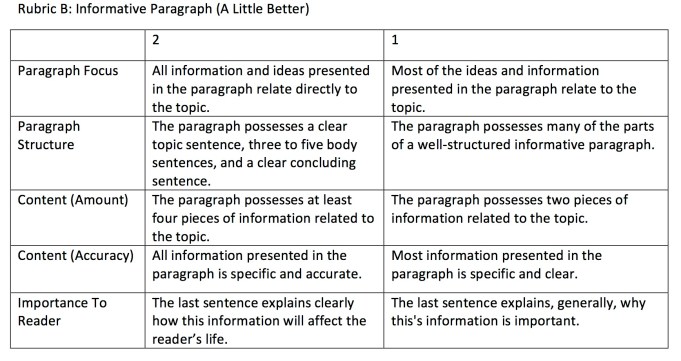
The questions raised during the parent conference can be boiled down to one consideration—did the student demonstrate a particular ability or understanding or not? Under rubric A, a score of 3, 5, 6, or 7 for a given requirement may indicate a degree of competency in the mind of the teacher, but it is not a clear degree conveyed to the student and parent. Under rubric B, the student “got it” or didn’t. Rubric B’s grades communicate competency to all parties more clearly than those generated by rubric A, but rubric B is still not valid.
A qualifier is a description of what a student’s work must show in order to receive a given grade or score, and well-written qualifiers can increase a rubric’s validity. Clear qualifiers connected to specific assessment requirements are just as important as small rubric numbers. In fact, if the response to a qualifier cannot be expressed as a “yes” or “no” response, the qualifier is probably too vague or describing too much.
Take another look at rubric B. “Content (Accuracy)” is worth two points and described with a single row of two qualifiers. What would a score of 1 communicate? It could mean the student provided two or three pieces of accurate information, some of the information was not considered specific, 50% of the information was correct given the 1 out of 2 points, or a variety of other possibilities. These questions do not even identify the inaccurate or non-specific pieces of information—especially if the teacher does not provide comments directly on the work.
Consider rubric C. The content accuracy requirement is still proportional to rubrics A and B, but four rows are now used to communicate what the teacher expected the student to do in terms of accuracy and quantity and also addresses the accuracy of information in specific body sentences.
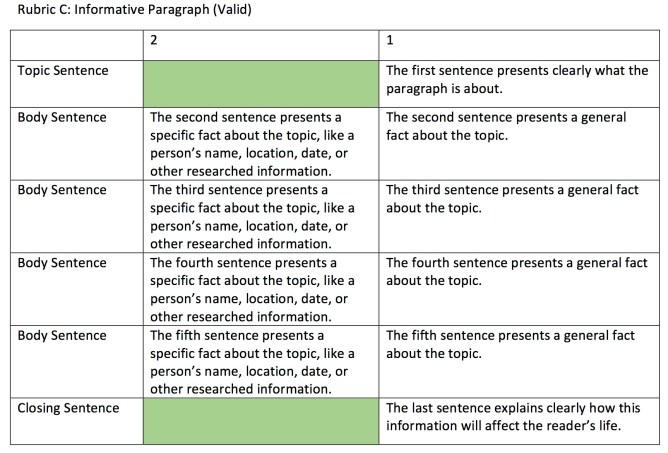
Smaller point values represent whether the student completed each requirement successfully or not, and the qualifiers describe reasonably what the student must do. There is less subjectivity in the scores than in the previous rubrics.
Imagine again you are a parent in a teacher conference. This time, your child received a grade of 8/10 on rubric C. Same B- or 80% total grade as received on rubric A, same weaknesses in the work (poor topic sentence and content issues with the second body sentence), and same report card grade of B+ at the end of the marking period. Do you have the same questions for the teacher regarding the project’s grade? The teacher’s rubrics’ total points and quantifiers have been consistently small through the marking period, and the teacher’s qualifiers have been like those represented in rubric C. Would you have the same questions for the teacher at the end of the marking period as you would in the first scenario? How is this marking period’s grade more valid, more clear, to you as a parent?
Now, consider this role reversal… Which teacher would you want to be during a parent conference—the teacher in the first scenario using rubric A to support the child’s grade or the teacher using rubric C in the second scenario? A grade is valid if it represents what it is intended to represent and provides specific and meaningful feedback to teachers, parents, and students. Keeping a rubric’s quantifiers (numbers of points) small and connecting clear qualifiers directly to project requirements can go a long way in providing valid grades.
 david cooper writing
You must be logged in to post a comment.