Nineteen, a freshman in a sophomore-level education class, my first week of college, and my prof assigned an article summary on an education-based topic of our choosing– one line of directions in a syllabus and a point value. Being nineteen and a freshman loving to write, I read this as an invitation to compose an article. Obviously, I had much to contribute to education given my seven days of intensive study in the field.
I spent hours at my poorly-lit dorm desk writing bits of conceptual genius on file cards, arranging and rearranging these puzzle-like on my floor, and crafting Victorian-like paragraphs with almost as many adverbs as adjectives. Little did I know the “article summary” term in the syllabus referred to a particular, college-specific assignment taught in the English composition classes, classes I did not have to take due to high school Advanced Placement credits.
My lack of references to a journal, unique formatting, and “outside-the-box” thinking went unappreciated. At least, that’s what I gleaned from the “D.” Or, was that a “D minus?” Besides the grade, I received a bit of advice scrawled in the margin, “Please visit the library’s writing center.” The absence of 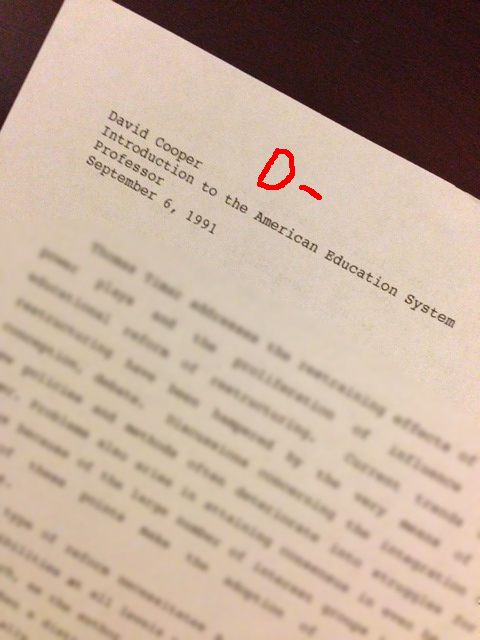 additional comments, more than the grade, opened a hole in my gut just big enough for my heart. What about my ideas? Wouldn’t an article like this be helpful to those wanting to teach? Couldn’t I write something like this, some day?
The retired professors at the center helped me immensely; specifically, they provided me with the requirements for an “article summary” and told me I needed the college’s composition style guide. Their help and the style guide led me to an “A” on my next assignment.
Naivety aside, I preferred my first submission. It possessed enthusiasm, a love for education and writing. I may not have supported my ideas with quantitative analyses, may not have provided appropriate American Psychological Association headings and subheadings, but I certainly didn’t rehash someone else’s ideas for the sake of demonstrating my ability to read. Maybe there is a place for naivety in writing.
I certainly know the value of finding and reading professional research, and I try to impart this upon my students every year; yet I urge teachers and writers to recognize and inspire enthusiasm. Writing is not simply an act of repeating information and others’ ideas but a means of forwarding something of personal and societal value– a search for new ideas. Identify and harness enthusiasm, be clear with expectations for yourself and others, and leave plenty of room for creativity, a little space for healthy naivety… and buy a style guide.
 david cooper writing
You must be logged in to post a comment.