The Scourged Back, an 1863 photo of an escaped African American slave, his back covered by a thatch of thick scars, touches students more deeply and reveals more about this period of our nation’s history than could any third-person text. My student teacher and I posted The Scourged Back, period illustrations of slave-catchers, sepia photos of slave quarters, and discussion prompts around our classroom. Students moved from image to image responding collaboratively to high-order questions while reflecting upon issues of fairness and cruelty. The activity reached beyond descriptions of slavery as an institution and into the affective domain by addressing the practice on emotional levels.
How do I balance emotional impact against potential triggers?
Providing students with opportunities to feel (experience) the human side of historical events while avoiding triggers can be a difficult dance. Students learn so much from emotion, and delivering history without human elements do many disservices to those whose stories we tell. At the same time, trauma is a very real and ever-present part of many students’ lives. Avoid attaching affective strategies to actively violent content even if the media presented is not graphic in nature. Weigh the use of resources with an eye for detail and consideration for potential trauma response triggers. Sometimes a subtle difference between media choices can make a big difference.

Credit: Mother Taken Away. American anti-slavery almanac, for 1838 Boston: Published by D.K. Hitchcock, 1837. Accessible https://digital.librarycompany.org/islandora/object/Islandora%3A2752. The Library Company of Philadelphia.
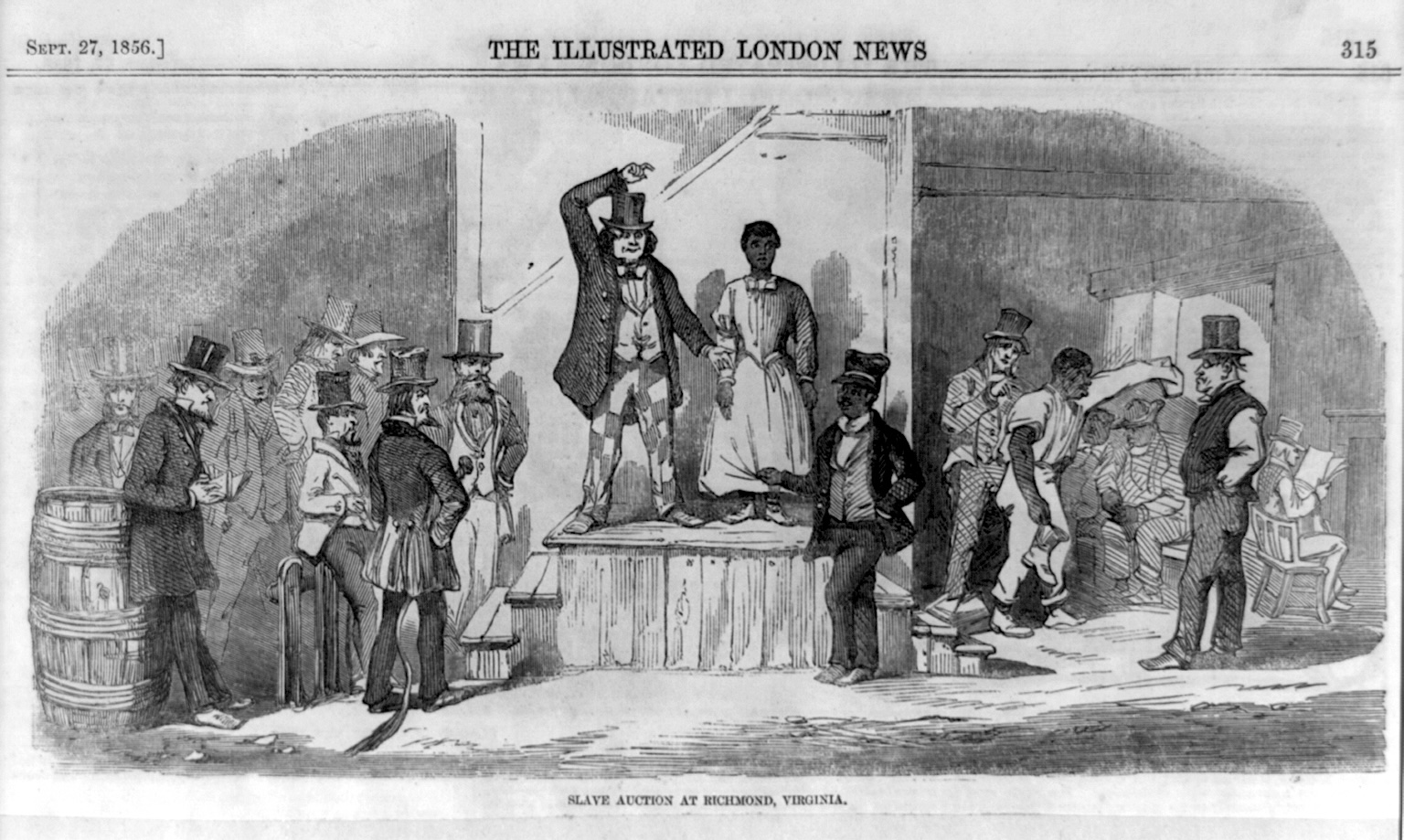
Credit: Slave Auction at Richmond Virginia. Illustration from The illustrated London news, 1856 Sept. 27, p. 315. Library of Congress Prints and Photographs Division. Accessible https://www.loc.gov/pictures/item/98510266/
These primary-source images capture scenes from the auctioning of enslaved persons, which are inherently emotional. Students viewing such images are always moved, and this is an impactful way to address the issue of slavery. Consider, from the standpoint of trauma-informed practice, the image on the left shows a mother being separated from her children during the course of a sale while the image on the right features a single woman. What may seem like a subtle difference between these images can have a serious unintended consequence. Students who have experienced some type of traumatic separation from adult figures may find the image on the left a trigger, while the image on the right may not evoke a trauma response yet yield the desired opportunity to engage history on an emotional level.
How do I scaffold questioning to reach the affective domain?
Some students will be able to dive right into explorations of their emotional reactions to media and historical events, but many will need some help to build to these higher-levels of thought and expression. Begin with some concrete observational questions to encourage a close examination of the media:
- Where is this scene/event taking place?
- When is this scene/event taking place?
- Who is in the scene/event?
- What is happening in the foreground of the scene/event?
- What is happening in the background of the scene/event?
Now, build to some interpretive types of questions:
- What facial expressions do you see?
- What emotions do you think the people are experiencing?
- How would you feel if you were in the scene/event?
- How do you feel observing the scene/event?
- Is what is happening in the scene/event fair? Why or why not?
- What do you think the creator of this [media type] wants you to feel? Why?
- What would you change about the scene or event if you could?
Once students have collected their information (observations) and have made some guided interpretations, a summative activity involving the expression of how they feel about the content can provide students an opportunity to react fully to the event and draw some emotional conclusions. The emotional impact will result in your lesson objectives staying with students much longer and in more meaningful ways than traditional, limited “tell me what you see” and “tell me what happened” approaches.
Where do you get your primary source images?
Many images I use for my classroom and teaching publications come from the Library of Congress Prints and Photographs Online Collection and are free of copyright restrictions, particularly those of our country’s early history. Information regarding copyright is provided for each image in the cataloging profile, but all images, regardless of the description of permitted use, include the disclaimer “Rights assessment is your responsibility” to protect the library’s legal interests. I advise providing bibliographic references for any image used to offer proper credit to the image creator and to model responsible and ethical research for students.
 david cooper writing
You must be logged in to post a comment.